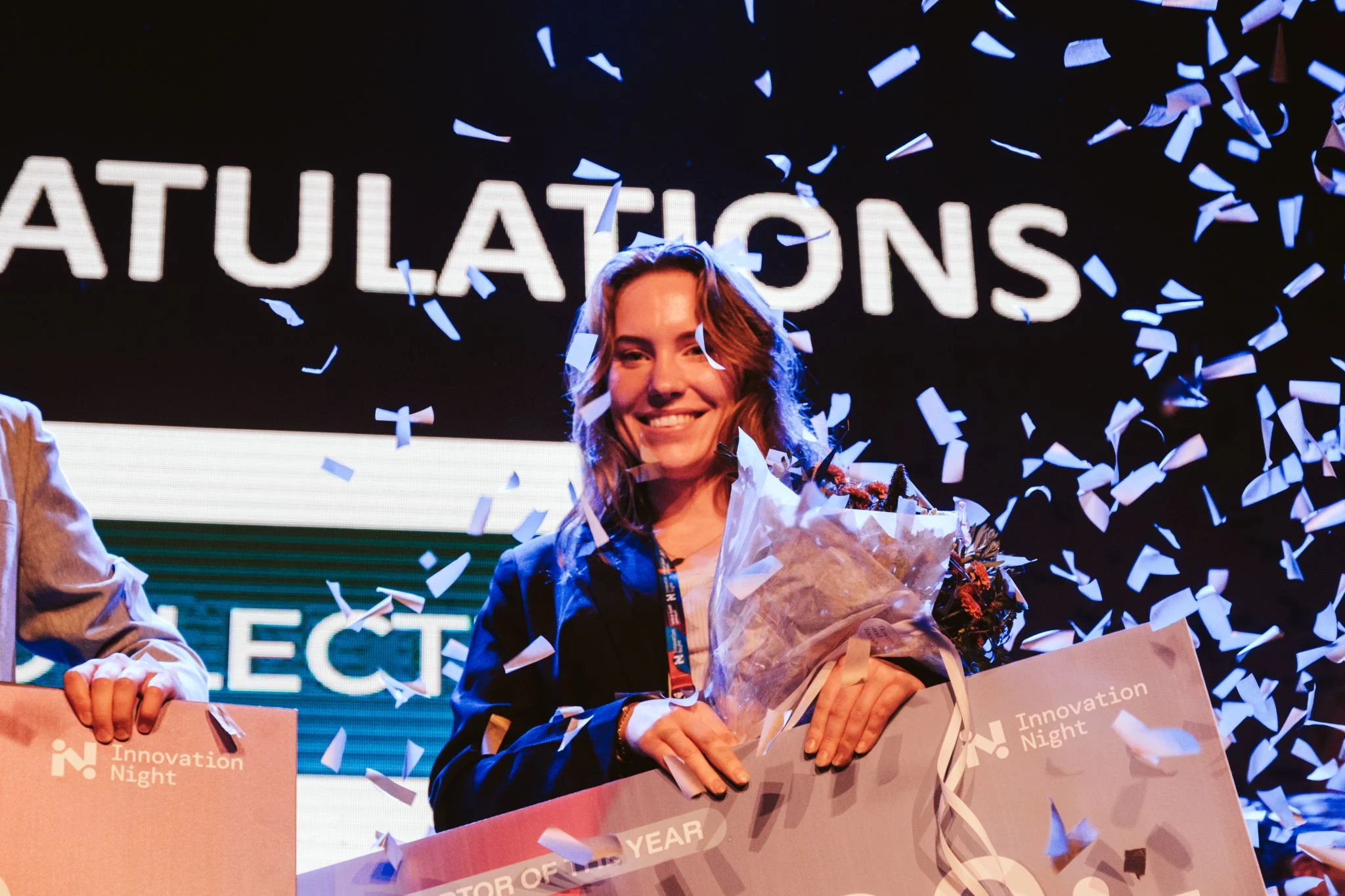
Bioelectrix has won the national Disruptor of the Year pitch competition at Innovation Night in Uppsala, taking the title and SEK 100,000 for its bioelectronic approach to chronic wound care.
More than 600 people gathered in central Uppsala for the second edition of Innovation Night, where around 40 companies exhibited and eight startups from across Sweden were selected to pitch in the national Disruptor of the Year competition. After the eight pitches, an expert jury selected two finalists, Bioelectrix and Acorai, who presented again during the Grand Finale Dinner before the audience voted.
Bioelectrix was named Disruptor of the Year 2026. The companies were assessed on innovation, scalability and sustainability⚡️
Chronic wounds rarely get this kind of attention. They affect an estimated 1 to 2 per cent of the population in developed countries, diabetic foot ulcers precede around 85 per cent of diabetes-related amputations, and the cost to European health systems runs to billions of euros each year. Yet most of what wound care offers today is passive: cover, protect, wait. A room of investors, clinicians and entrepreneurs choosing this problem says something about how ready the field is for change
We were also glad that the jury and the audience recognised what makes our approach different from electrical stimulation as it has been tried before. Skin generates its own electric fields, and those fields act as a directional cue that guides cells into a wound. Direct current is the signal the body actually uses. It has largely been avoided in practice because conventional metallic electrodes produce damaging by-products when direct current is delivered for any useful length of time, which is why most existing systems rely on pulsed or alternating currents instead.
Our starting point is a material interface, developed from bioelectronics research at Chalmers University of Technology and the University of Freiburg, that allows sustained direct current to be delivered safely. The electrodes sit beside the wound rather than in it, so the device is designed to work with standard dressings and existing clinical routines, and the same fabrication process lets us build sensing into the dressing itself.
That is the disruption: not stimulation as an add-on, but restoring the healing signal itself.
Thank you to UIC, Uppsala Innovation Centre and everyone across the Uppsala innovation ecosystem who made the evening possible, and to the generosity of the people we met there. Congratulations to Acorai, and to Besca, GenomeVault, Jocky, SampleFacts, Sortrace and Veltio Pharma.
Thank you for the support and recognition!
Congratulations to Acorai, runner-up on the night, and to the other startups who took the stage: Besca, GenomeVault, Jocky, SampleFacts, Sortrace and Veltio Pharma.
Read the full story 👉 https://lnkd.in/davjcSRU