Our Story
The beginning
Seeds in Freiburg, Germany
Bioelectrix traces its roots to the University of Freiburg, where our founders explored how subtle electrical cues influence cell behavior and tissue repair. Those years in the lab taught us two things: bioelectricity matters, and translating it responsibly would take persistence.
At Bioelectrix, our journey began with a simple question: what if we could help the body heal itself faster using electricity?
For most people, a small wound is a minor inconvenience. It heals quickly and is soon forgotten. But for millions worldwide, especially people living with diabetes, poor circulation, or limited mobility, even a small wound can become serious and sometimes life-threatening.
When we began studying this challenge, we found that the body already uses electricity to support healing. Skin cells respond to tiny electrical signals that help guide where they move and what they do.
But skin is different from the brain or muscles which the science originated from. To influence skin cells and support healing, electrical stimulation must be gentle and continuous over longer periods. Traditional electrode materials, such as metals used in many medical devices, are not well suited for this. Over time, they can trigger unwanted chemical reactions, including gas formation or pH changes, that may harm sensitive wound tissue.
That is the problem we set out to solve.

Click to view in fullscreen
Bridging the gap
Where Bioelectronics Meets Healing
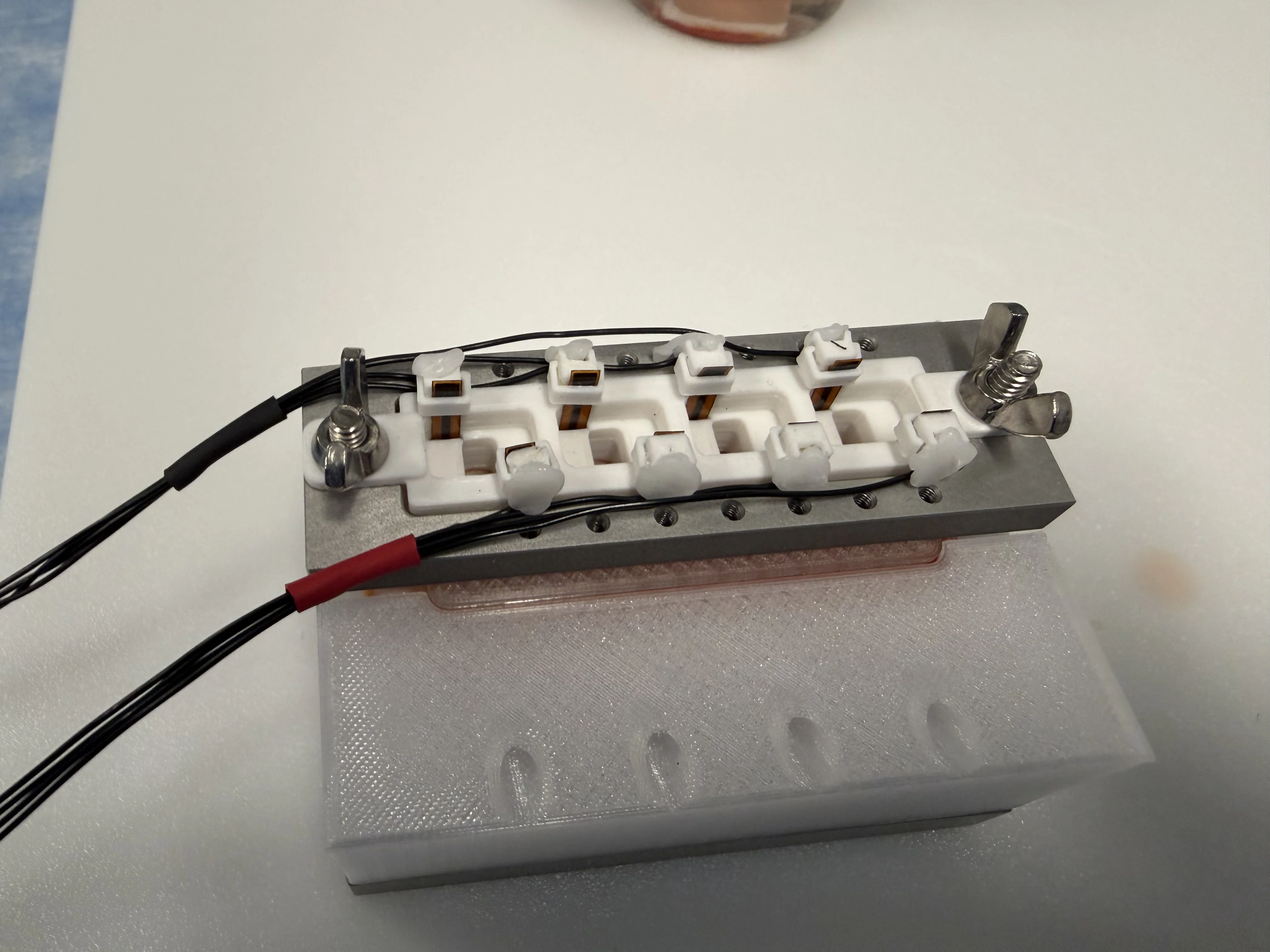
Our research focused on developing materials that could deliver electrical stimulation safely over long periods without causing harmful reactions. After years of work, we found a solution.
These materials conduct electrical current in a stable, controlled way, enabling gentle stimulation of tissue over time.
Using this platform, we studied how human skin cells behave in electric fields. We found that cells can sense electricity and move in response, migrating together in a coordinated direction when exposed to the right signals.
In lab experiments with artificial wounds in skin cell layers, electrical stimulation greatly sped up healing. The cells closed the wound gap up to three times faster than untreated samples. Even under more challenging conditions, such as diabetic-like cells or disrupted cell communication, stimulation still helped guide healing.
These early results gave us confidence that the technology could eventually become a real medical solution.
Mission
From Research to Real-World Impact
Turning a scientific breakthrough into a medical treatment requires many steps. Beyond laboratory experiments, we must ensure the technology works safely in real tissue and ultimately in patients.
To move closer to clinical reality, we began collaborating with partners who specialize in testing wound-care therapies on donated human skin from surgical procedures. These models allow researchers to study wound healing in real human tissue under controlled conditions.
At the same time, we are developing the next generation of our device designed not just to work in the lab, but to fit seamlessly into everyday clinical practice.
Our goal is to create a technology that healthcare professionals can easily integrate into their workflow while providing meaningful improvements for patients.
WHY now?
Silent pandemic
Chronic wounds are one of healthcare’s most underestimated challenges. As populations age and conditions like diabetes and obesity become more common, the number of people suffering from hard-to-heal wounds continues to rise.
For patients, these wounds can mean pain, isolation, and a dramatically reduced quality of life. For healthcare systems, they represent a growing economic burden that requires long-term care and repeated clinical visits.
At Bioelectrix, we believe that electrical stimulation—delivered in the right way—can fundamentally change how these wounds are treated.
Instead of simply managing wounds and waiting for the body to heal on its own, our vision is to actively trigger the body’s natural repair mechanisms and help tissue recover faster.
The present
Building Bioelectrix
We are headquartered in Gothenburg, Sweden, with strong ties to Germany through our founders and the origins of the technology. We partner with care teams and researchers to refine usability and build evidence, starting with diabetic foot ulcers.
Becoming
With the support of Chalmers Ventures, our wonderful advisory board and close conversations with clinicians we founded Bioelectrix to bridge academic excellence with day-to-day care.
Our approach is pragmatic: design with nurses and physicians, validate with data, and communicate with humility.
What Drives Us
Scientific Excellence
We translate deep biomedical research into tools that stand up to scrutiny. If we can’t support it, we won’t say it.
Human Impact
Collaboration
We’re fortunate to collaborate with clinicians and researchers across Sweden and Germany and to be supported by Chalmers Ventures. Their belief in careful, evidence-first innovation helps us keep the bar high.